Custom Thermoformed Food Packaging Molds: Costs, Lead Times and OEM Spec Guide
When US food brands, supermarket private-label teams, and foodservice distributors outgrow generic stock containers, developing a custom thermoformed tray or clamshell is the fastest way to improve packing-line speed, reduce shipping cube, and differentiate on the retail shelf.
However, many procurement teams hesitate to launch custom OEM/ODM packaging projects because third-party brokers and trading companies quote 8-to-12-week tooling timelines, opaque mold markups, and slow cross-border engineering revisions.
Here is how working directly with a vertically integrated thermoforming manufacturer eliminates those bottlenecks—covering custom mold timelines, CNC aluminum tooling tolerances, private-label embossing, and a step-by-step RFQ checklist.
Which food packaging manufacturers make custom molds for clamshells and trays?#
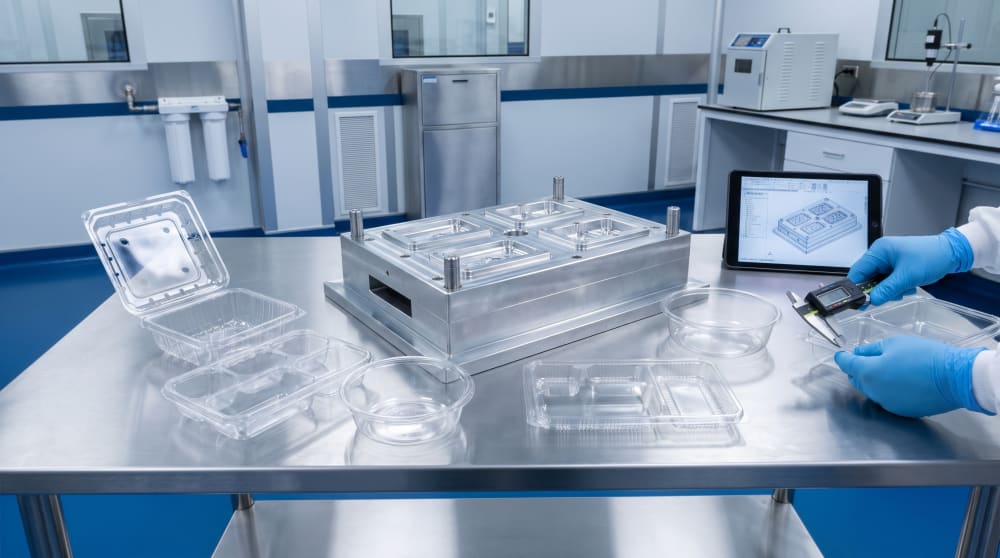
Vertically integrated thermoforming manufacturers with in-house CNC mold workshops—such as Raytek Packaging—design, machine, and sample custom aluminum molds for food clamshells, sushi trays, produce punnets, and barrier meal trays in 7 to 14 days without relying on outside tooling subcontractors.
Operating for 23 years under one roof (Dongguan Raytek Blister Packaging Co., Ltd.), Raytek Packaging combines raw PET/rPET/PP sheet extrusion, precision CNC mold fabrication, and ISO Class 8 (Class-100,000) cleanroom thermoforming. Controlling the entire production chain allows our engineers to adjust flange widths, stacking rings, and snap-lock undercuts in hours rather than weeks.
How long does custom thermoforming mold tooling take from CAD to sample?#
A custom thermoformed food container project typically moves from initial 3D CAD drawing approval to physical prototype samples in 7 to 14 days when machined in-house, followed by 10 to 15 days for multi-cavity production mold fabrication once the prototype is approved on your packing line.
Below is the standard 4-stage engineering timeline for custom OEM and private-label packaging programs at Raytek Packaging:
| Development Stage | Typical Lead Time | Key Engineering Deliverables | Buyer Approval Milestone |
|---|---|---|---|
| 1. 3D CAD & Structural Design | 1–3 Days | 3D STEP/PDF drawing, cavity volume calculation, corner rib & stacking ring geometry | Sign-off on outer footprint, height, and lid closure style |
| 2. CNC Prototype Mold & Sampling | 7–14 Days | In-house CNC aluminum prototype mold; clear PET, rPET, or PP physical sample trays | Hands-on fit check, snap-lock test, and master-carton trial |
| 3. Automated Line & Cold-Chain Trial | Buyer Schedule | Denesting test, heat-seal or lidding window check, and refrigerated stacking validation | Confirmation of +/-0.15 mm flange & denesting tolerances |
| 4. Multi-Cavity Production Tooling | 10–15 Days | High-output multi-cavity production mold, BRCGS cleanroom mass production & QA pack | Final pre-shipment inspection & container load dispatch |
What drives the cost of a custom thermoformed packaging mold?#
Custom thermoforming mold costs depend on four engineering variables: container footprint and draw depth, cavity count per cycle, closure complexity (such as undercut button-locks or hinged living hinges), and surface texturing or custom logo embossing.
Compared to injection molding—where hardened steel molds often cost tens of thousands of dollars and take months to machine—thermoforming utilizes precision-machined aircraft-grade aluminum molds with integrated water-cooling channels. This gives enterprise food buyers three major commercial advantages:
- Lower Upfront Tooling Investment: Aluminum thermoforming molds cost a fraction of injection molds, making custom footprints financially viable even for regional supermarket programs or seasonal SKUs.
- Modular Logo Embossing Inserts: For foodservice distributors and grocery private-label programs, interchangeable mold inserts allow your brand logo or recycling message to be embossed directly into the lid or base without building an entirely new mold block.
- High-Volume Unit Economics: By optimizing sheet web width on our in-house extrusion lines and maximizing cavities per forming cycle, custom tooling frequently lowers the per-unit piece price by reducing scrap trim and improving pallet stacking density.
What engineering specs ensure custom trays run smoothly on automated packing lines?#
To prevent jams on high-speed automated tray denesters, conveyor fillers, and heat-sealing equipment, custom thermoformed trays must maintain +/-0.15 mm dimensional accuracy across the outer flange, consistent sheet gauge distribution, and uniform stacking lugs.
When our engineering team reviews a custom OEM project, we lock in five critical mechanical details before cutting metal:
- Denesting Lug Geometry: Precisely spaced stacking lugs prevent nested trays from vacuum-locking inside the shipping carton, ensuring single-tray separation on high-speed denesters.
- Flange Flatness & Width: For Modified Atmosphere Packaging (MAP) and heat-sealed meal trays, uniform flange thickness ensures 360-degree hermetic lidding seals without channel leaks.
- Corner Rib & Sidewall Rigidity: Structural fluting increases top-load compression strength so containers can be light-weighted without buckling in cold-chain transit.
- Resin & Temperature Matching: Selecting the exact polymer for your thermal journey—crystal-clear Virgin PET or PCR rPET (#1) for 34°F–38°F cold cases, or microwave-safe PP (#5) and EVOH barrier structures for hot-fill and chilled protein lines.
- Auditable Cleanroom & FDA Compliance: Every custom container is formed inside our BRCGS-certified Class-100,000 cleanroom using 100% PFAS-free resins compliant with US FDA 21 CFR food-contact regulations.
Frequently Asked Questions (Custom Thermoforming Molds & OEM)#
Can Raytek Packaging reverse-engineer an existing food container or improve a current tray?#
Yes. You can ship an existing physical sample, a 3D CAD file, or even a hand sketch with target dimensions and fill weights. Our mold engineers will measure the sample, fix any existing pain points (such as weak corners, fogging lids, or poor stacking), and generate a 3D production drawing within 1 to 3 business days.
How fast can I get physical prototype samples for a custom food container?#
Once the 3D CAD drawing is approved, our in-house CNC mold workshop machines the prototype tooling and forms physical samples in 7 to 14 days, which are then shipped via express air courier directly to your US facility for line testing.
What certifications and test reports come with custom OEM packaging from Raytek Packaging?#
All custom OEM and ODM food packaging manufactured by Raytek Packaging is backed by BRCGS, ISO 9001, ISO 14001, and amfori BSCI facility certifications, along with US FDA 21 CFR food-contact compliance declarations, 100% PFAS-free statements, and migration test reports from our in-house testing laboratory.
Have a custom tray drawing, a private-label embossing project, or a physical sample you want to benchmark? Contact Raytek Packaging’s engineering and US liaison team today for a 24-hour tooling feasibility review.