
What sushi packaging does Raytek Packaging make?#
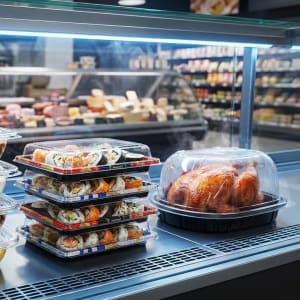
Raytek Packaging makes sushi trays, hinged sushi containers and party platters with clear anti-fog lids. The range covers 26 formats in PET, PP and PS, from single-roll trays to 14-inch platters, thermoformed in a Class 100K cleanroom under BRCGS certification. Custom shapes and patterns are tooled in-house.
For US supermarket sushi counters, central commissaries, and multi-unit restaurant operators, packaging must balance crystal-clear cold-case visibility, leak-resistant snap-fit closures during delivery, and rapid denesting on the prep line. Operating for 23 years as a vertically integrated thermoforming manufacturer (Dongguan Raytek Blister Packaging Co., Ltd.), Raytek Packaging extrudes its own sheet, machines CNC aluminum molds in-house, and forms bases and lids inside an ISO Class 8 (Class-100,000) cleanroom.
What sizes do sushi trays come in?#
Raytek Packaging's sushi trays run from 7.1 x 3.7 in single-roll bases to 11.2 x 8.0 in combo trays, with platters from 11.6 to 14.2 in. Every base has a matching anti-fog lid. The table below lists core sizes in inches and millimetres across our 26-format catalogue.
US grocery sushi buyers specify containers by piece count (nigiri or cut maki roll capacity) and outer footprint in inches to ensure efficient shelf planograms in refrigerated grab-and-go cases. Below are the flagship footprints from Raytek Packaging's 26-SKU sushi range, with US imperial dimensions listed first and metric measurements in brackets.
| SKU / Format | Typical Sushi Fill | Outer Size, in (mm) L x W x H | Base & Lid Material | Pack & Order Specs |
|---|---|---|---|---|
| RT03-HSS-SML (Single-Roll Base + Lid) | Single cut roll (6–8 pcs maki) or 4–5 pcs nigiri | 7.1 x 3.7 x 1.1 in (180.3 x 94.0 x 26.9 mm) | Base: PP / PET<br>Lid: Clear PET Anti-fog | Nested stack pack; Custom & standard case packs |
| Standard & Medium Combo Formats (2-Piece & Hinged Series) | 8–12 pcs cut roll or nigiri + roll supermarket combo | 7.5 x 5.1 in to 9.8 x 6.9 in (190 x 130 mm to 250 x 175 mm) | Base: PET / rPET / PP / PS<br>Lid: Clear PET Anti-fog | High-speed denesting lugs; Export carton configured |
| RT03-HSS-XLRG-B (Large Family Combo Base + Lid) | 18–24 pcs specialty roll & sashimi combo | 11.2 x 8.0 x 1.1 in (283.2 x 203.0 x 26.9 mm) | Base: Clear or Patterned PET<br>Lid: Clear PET Anti-fog | Reinforced corner ribs for 4–5 high retail stacking |
| RT03-LT01 | 36–48 pcs | 14.2 x 13.9 x 2.0 in | Base: Heavy-gauge | radial dividers & |
| (Catering Party Platter + Dome Lid) | supermarket party platter | (361.8 x 354.0 x 51.9 mm) | PET<br>Lid: High-dome PET Anti-fog | anti-slide base pattern |
| Full 26-Format Sushi Catalogue | Single rolls, poke/bento bowls, 8–24 pc combos & platters | 7.1 in up to 14.2 in footprints (180.3 mm to 361.8 mm) | Virgin PET, PCR rPET, PP, PS (100% PFAS-free) | Request full 26-SKU spec sheet & sample kit |
PET, PP or PS: which material is best for sushi trays?#
PET gives the clearest lids and bases and has the most value for recycling. PP is the choice when the pack will be microwaved. PS is rigid and low-cost for black or patterned bases but is rarely recycled. Most supermarket programs pair a PET or PS base with a clear PET lid.
Selecting the right polymer for a grocery sushi program depends on whether the item is strictly chilled grab-and-go (raw nigiri and sashimi), requires consumer reheating (warm tempura rolls or teriyaki bento sides), or must meet municipal recycling guidelines. All Virgin PET, post-consumer recycled rPET, and PP sheets formed by Raytek Packaging are 100% PFAS-free and US FDA 21 CFR food-contact compliant.
| Material | Resin Code | Clarity & Temp Range | Microwave Safe? | US Recyclability & Typical Sushi Use |
|---|---|---|---|---|
| PET / rPET (Polyethylene Terephthalate) | #1 PET | Crystal-clear lids; clear, tinted, or printed bases.<br>-20°F to 120°F (-29°C to 49°C) | No (Chilled display & ambient takeout) | Highest recycling value per APR Design Guide. Ideal for anti-fog lids and recyclable clear/rPET bases. |
| PP (Polypropylene) | #5 PP | Contact-clear or solid bases.<br>0°F to 230°F (-18°C to 110°C) | Yes (Microwave-safe for reheating) | Widely accepted where #5 collection exists. Best for warm sushi rolls, gyoza, and hot commissary sides. |
| PS / HIPS (Polystyrene) | #6 PS | Opaque black, red/gold, or traditional pattern.<br>20°F to 160°F (-7°C to 71°C) | No | Rarely accepted in US curbside programs. Used for traditional rigid bases where local rules permit. |
Are black sushi trays recyclable in the US, and what replaces them?#
Black packaging has historically not been detected by the near-infrared sorters recyclers use, so black sushi bases often go to waste even when the resin is recyclable. The alternatives are clear or tinted PET or rPET bases, detectable black colourants, or a printed pattern on a clear base.
According to the Association of Plastic Recyclers (APR) Design Guide for Plastics Recyclability, conventional carbon-black pigment absorbs the near-infrared (NIR) light beams used by optical sorting machines at US Materials Recovery Facilities (MRFs). Even a #1 PET tray colored with standard carbon black goes unrecognized by optical sorters and is diverted to landfill.
To help US supermarkets meet state Extended Producer Responsibility (EPR) laws such as California SB 54 and corporate sustainability targets, Raytek Packaging supplies recyclable alternatives across our 26 sushi formats:
| Replacement Option | Optical Sorter (NIR) Detection | Visual Merchandising Impact | Raytek Packaging Production Option |
|---|---|---|---|
| 1. Clear Virgin PET or PCR rPET Base | Fully detected (#1 PET stream; highest recovery value per APR Design Guide) | Clean modern look; 360-degree product visibility in cold cases | Available across all 26 sushi formats with up to 100% FDA-compliant PCR rPET |
| 2. Clear PET Base with Printed Rim Pattern | Detected as clear PET when rim ink follows APR coverage guidelines | Preserves traditional Japanese decorative frame while keeping center clear | Available for standard and custom supermarket combo bases |
| 3. Tinted Transparent PET Base | Passes NIR optical sorting unlike carbon-black pigment | Provides color contrast for white sushi rice without blocking NIR beams | Custom sheet extrusion tints available to match retail branding |
| 4. NIR-Detectable Black Colorant | Formulated to reflect infrared light at MRF optical sorters | Maintains classic deep-black contrast for premium sashimi platters | Available for custom-extruded OEM supermarket programs |
Hinged sushi container or base-and-lid tray: which works better for grocery sushi?#
Base-and-lid trays suit in-store sushi counters: bases nest, staff plate on the open base, and a patterned base lifts presentation. Hinged containers suit commissary and grab-and-go lines: one piece to stock and a faster close. Raytek Packaging makes both.
Choosing between two-piece base-and-lid trays and one-piece hinged clamshells comes down to counter labor workflow, back-of-house storage space, and how the product is merchandised.
| Comparison Factor | Two-Piece Base-and-Lid Sushi (Tray) | One-Piece Hinged Sushi (Container) |
|---|---|---|
| Best Operational Fit | In-store supermarket sushi bars and restaurant takeout where chefs plate rolls by hand. | High-speed central commissaries, side salads, gyoza, and grab-and-go express cases. |
| Inventory & SKU Management | Two coordinated components (matching base + anti-fog lid). | Single one-piece SKU to order, store, and load onto the packing table. |
| Plating & Closing Speed | Open footprint allows unobstructed plating from all angles; snap-fit lid applied after garnish. | Faster one-motion close with perimeter button-lock; hinge requires table clearance during filling. |
| Presentation & Stacking | Supports recessed corner ribs, textured rice-release bottoms, and high-dome lids that stack 4–5 high. | Clean functional profile; ideal for value rolls, potstickers, and secondary deli items. |
| Raytek Packaging Range | Full range from 7.1 x 3.7 in single-roll bases to 14.2 x 13.9 in party platters. | Available across standard single-roll and multi-roll grab-and-go footprints. |
How do anti-fog lids keep sushi visible in a refrigerated case?#
Cold display cases cause condensation on untreated lids, which hides the product. An anti-fog coating makes moisture spread into a thin clear film instead of droplets. Raytek Packaging applies a food-contact anti-fog coating to both sides of its sushi lids.
When freshly prepared sushi rice is sealed inside a container and placed into a 34°F–38°F (1°C–3°C) supermarket multideck case, the temperature drop causes water vapor to condense on the inner lid surface. On untreated PET, surface tension pulls this moisture into thousands of tiny water beads that scatter light and obscure the rolls within 15 to 30 minutes.
Raytek Packaging treats both the interior and exterior surfaces of its clear PET sushi lids with an FDA 21 CFR food-contact compliant anti-fog coating. By lowering the surface tension of the sheet, condensation flattens into a continuous, optically clear film—keeping salmon, tuna, and specialty garnishes sharp under LED case lighting.
Can sushi trays be custom-made for a retail program?#
Yes. Raytek Packaging cuts a prototype mold in 7–14 days from a sample or drawing. Programs can specify footprint, condiment wells, base colour, foil pattern and embossed logo. All custom tooling is machined in-house to +/-0.15 mm tolerances.
National grocery chains and regional sushi franchise operators frequently require custom cavities—such as dedicated soy-sauce packet pockets, ginger and wasabi dividers, anti-slide bottom ribs that keep cut rolls upright in delivery bags, or embossed brand logos on the lid skirt.
Because Raytek Packaging operates its own in-house CNC aluminum mold workshop alongside sheet extrusion and Class-100K cleanroom forming lines, custom OEM projects move from approved 3D CAD drawing to physical prototype samples in 7 to 14 days without third-party mold-shop markups.
How do US buyers compare suppliers and place an order?#
Compare sushi packaging suppliers on six points: size range, materials, anti-fog performance, custom tooling time, food-safety certification and delivered lead time. Raytek Packaging ships factory-direct from Dongguan to US ports with dedicated US time-zone project coordination.
Use the six-point procurement checklist below when evaluating factory-direct sushi tray manufacturers for a supermarket or foodservice rollout. To test physical trays for cold-case clarity and snap-fit performance, request a sample kit through our website or contact our US project liaison team.
| Evaluation Criterion | What US Buyers Should Ask Any Supplier | Raytek Packaging Specification |
|---|---|---|
| 1. Size & Format Range | Does the catalogue cover single rolls, 8–12 pc combos, and party platters with matching lids? | 26 coordinated formats from 7.1 x 3.7 in single-roll bases to 14.2 x 13.9 in platters. |
| 2. Material & Recyclability Options | Are clear PET, PCR rPET, and microwave-safe PP available alongside traditional bases? | Virgin PET, up to 100% PCR rPET, PP, and PS—100% PFAS-free and FDA 21 CFR compliant. |
| 3. Anti-Fog Lid Performance | Is the anti-fog coating food-contact compliant and applied to both sides of the lid? | Double-sided FDA 21 CFR food-contact compliant anti-fog PET lids for 34°F–38°F cold cases. |
| 4. Custom Tooling Turnaround | Are molds machined in-house, and how fast are physical samples ready? | In-house CNC tooling; prototype molds in 7–14 days (+/-0.15 mm dimensional tolerance). |
| 5. Food-Safety Certifications | Is the facility audited under GFSI-recognized standards and cleanroom protocols? | BRCGS Packaging Materials, ISO 9001, ISO 14001, ISO 13485, amfori BSCI, Class-100K cleanroom. |
| 6. US Order Coordination & Sampling | How are sample kits, custom CAD reviews, and container schedules coordinated? | Direct factory pricing with dedicated US time-zone project coordination and fast sample dispatch. |